Bora Bora
📍 Society Islands, French Polynesia
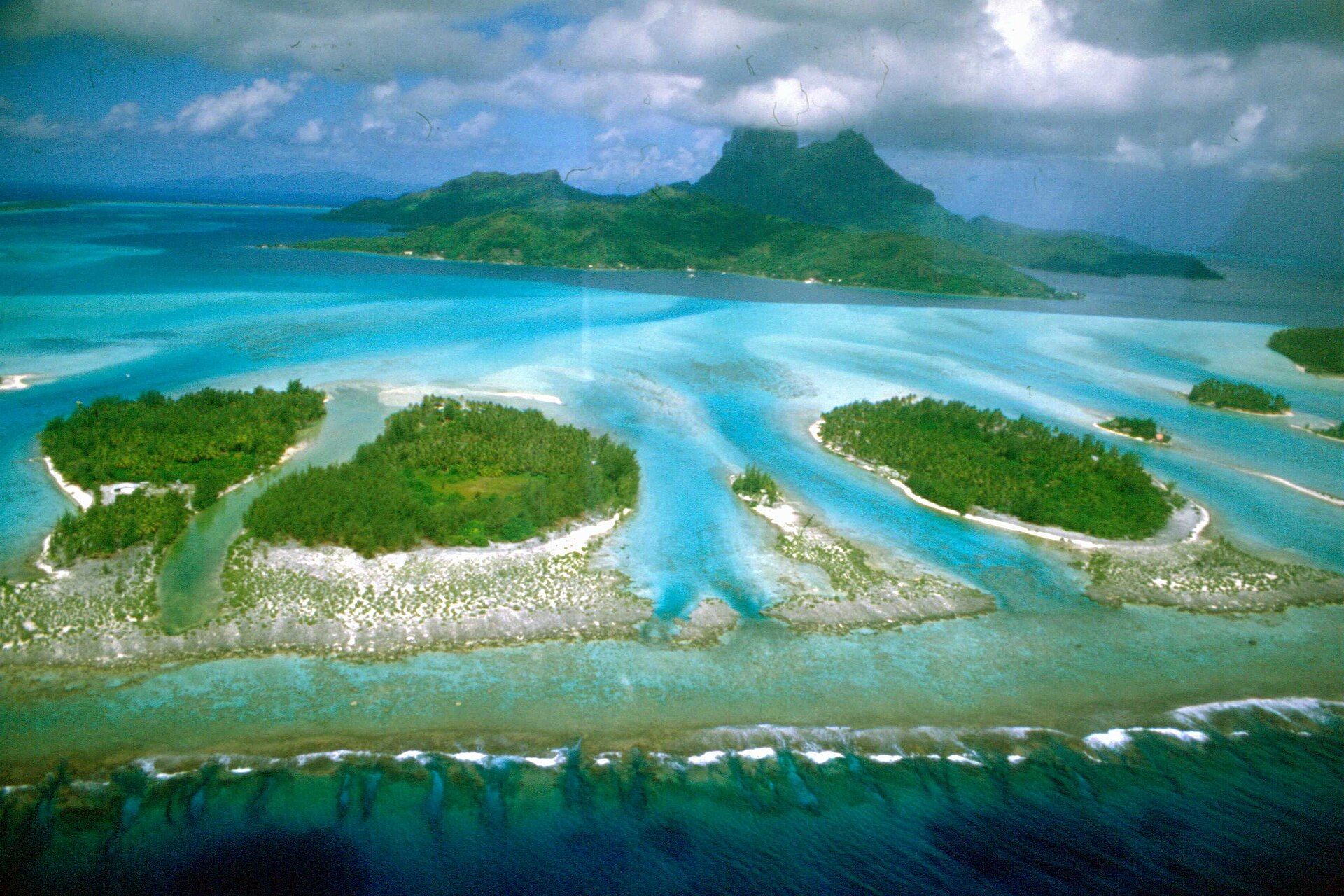
The archetypal South Pacific paradise — a jagged volcanic peak ringed by a luminous turquoise lagoon and a protective coral reef, encircled by palm-fringed islets of white sand.
What makes it marvelous
Bora Bora is the eroded remnant of an ancient volcano: the dramatic twin-peaked Mount Otemanu at its centre is the old volcanic core, while around it a barrier reef and a ring of small sandy islets (motu) enclose a shallow lagoon in astonishing shades of blue and green. In time — as with all such islands — the peak will sink and the reef will remain as an atoll, the very process Darwin described. The warm, clear, sheltered lagoon teems with rays, reef sharks, and coral, making it as rich underwater as it is beautiful above.
Why visit
Few places match the sheer postcard perfection of Bora Bora's lagoon: gliding over water so clear and vividly coloured it hardly looks real, snorkelling with rays and reef sharks, and watching the light change on Mount Otemanu. It's a byword for tropical paradise for good reason.
What to know before you go
🗓️ Best time
The dry season (roughly May–October) for sunshine, calm seas, and clear lagoon water; the wetter months (November–April) are hotter and more humid.
🧭 Getting there & access
By air from Tahiti (Papeete) to Bora Bora's island airport, then boat transfers across the lagoon to the island and its motu.
Good to know
- Snorkel or dive the lagoon for rays and reef sharks in clear, warm water.
- Use reef-safe sunscreen to protect the coral.
- The dry season offers the calmest, clearest lagoon conditions.
Plan your visit
Easy🧭 Getting there
From Bora Bora (BOB), via Papeete (PPT), Tahiti
- Long-haul flight to Papeete
- Inter-island flight Papeete → Bora Bora — about 50 minutes
- Boat transfer from the airport motu to your hotel or to Vaitape — 10–30 minutes
- Total travel
- Most of a day from Papeete, on top of the long-haul to get there
- Time at site
- 4–7 nights
- Access
- No permit needed. Lagoon tours and diving run through licensed operators. It is worth saying plainly that this is one of the most expensive destinations in the Pacific, and prices are not negotiable in the way they are in much of the tropics.
🎒 What to bring & consider
- Reef-safe sunscreen and a rash guard — the equatorial sun over water is severe and the lagoon coral is the entire attraction
- Reef booties for coral and coral-rubble beaches
- Repellent for the nono sandflies that come out on the beaches around dusk
- A dry bag, since almost everything you do happens by boat
- Considerably more budget headroom than you expect; nearly everything is imported
👁️ What to expect
- Crowds
- Low in absolute numbers, but the main lagoon snorkel sites collect several tour boats at once mid-morning.
- Conditions
- Hot and humid year-round. The wetter months bring heavy showers and more mosquitoes.
- Facilities
- Full at the resorts. Vaitape has shops, ATMs and a market. Between them, little.
- The view
- Mount Otemanu across the lagoon from an outer motu is the classic, and mornings are best — cloud builds on the peak as the day warms.
Times and requirements are approximate and change with season, weather, and local rules — confirm permits, fares, and schedules with operators before you travel.
Natural riches of the area
- An eroded volcanic peak within a barrier-reef lagoon
- A vivid, biodiverse coral lagoon (rays, reef sharks, coral)
- White-sand motu (islets) and clear warm waters
- A textbook example of island-to-atoll evolution
Local food
- Poisson cru
- Tahitian raw fish marinated in lime and coconut milk — the national dish.
- Fresh reef & pelagic fish
- Tuna, mahi-mahi, and reef fish from the surrounding waters.
- Tropical fruit & vanilla
- Papaya, pineapple, and the prized vanilla of the Society Islands.
Bora Bora is the South Pacific of the imagination: a jagged green volcanic peak rising from a lagoon of unbelievable blue, ringed by a coral reef and a necklace of palm-topped sand islets. The dramatic silhouette of Mount Otemanu is the worn-down core of an ancient volcano, and the reef and lagoon around it are a snapshot of island evolution frozen in time — one day the peak will sink and only the reef will remain, an atoll, exactly as Darwin worked out.
For now, the lagoon is the star. Warm, shallow, and sheltered, it glows in shades of turquoise and jade so vivid they barely look real, and beneath the surface it teems with rays, reef sharks, and coral. Whether you’re gliding across the water with the peak behind you or snorkelling among the fish, it’s easy to see why Bora Bora became the world’s shorthand for paradise.
Bora Bora: common questions
How do you get to Bora Bora?
From Bora Bora (BOB), via Papeete (PPT), Tahiti: Long-haul flight to Papeete; Inter-island flight Papeete → Bora Bora — about 50 minutes; Boat transfer from the airport motu to your hotel or to Vaitape — 10–30 minutes. Allow Most of a day from Papeete, on top of the long-haul to get there.
When is the best time to visit Bora Bora?
The dry season (roughly May–October) for sunshine, calm seas, and clear lagoon water; the wetter months (November–April) are hotter and more humid.
How long should you spend at Bora Bora?
4–7 nights. Most of a day from Papeete, on top of the long-haul to get there of travel from Bora Bora (BOB), via Papeete (PPT), Tahiti.
What should you bring to Bora Bora?
Reef-safe sunscreen and a rash guard — the equatorial sun over water is severe and the lagoon coral is the entire attraction Reef booties for coral and coral-rubble beaches Repellent for the nono sandflies that come out on the beaches around dusk A dry bag, since almost everything you do happens by boat Considerably more budget headroom than you expect; nearly everything is imported
Do you need a permit or guide for Bora Bora?
No permit needed. Lagoon tours and diving run through licensed operators. It is worth saying plainly that this is one of the most expensive destinations in the Pacific, and prices are not negotiable in the way they are in much of the tropics.
Is Bora Bora crowded, and what are conditions like?
Low in absolute numbers, but the main lagoon snorkel sites collect several tour boats at once mid-morning. Hot and humid year-round. The wetter months bring heavy showers and more mosquitoes. Facilities: full at the resorts. Vaitape has shops, ATMs and a market. Between them, little.
Added
More wonders to explore