Monument Valley
📍 Arizona–Utah border, Navajo Nation
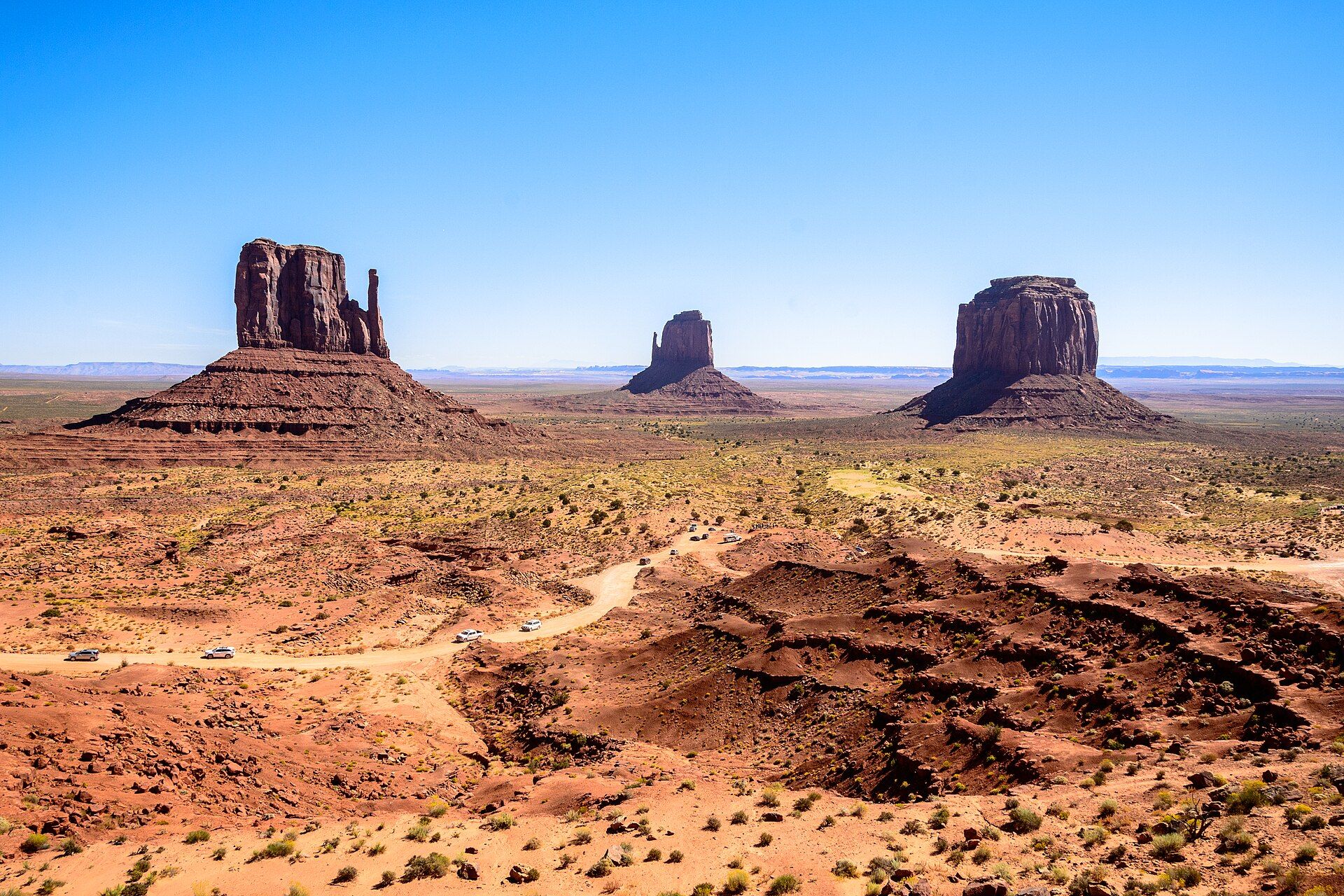
Colossal red sandstone buttes standing alone on a desert plain — the defining landscape of the American West, on Navajo land where the mesas rise up to 300 metres from the flats.
What makes it marvelous
Monument Valley is what remains after almost everything else has eroded away. What is now a broad desert plain was once a high plateau of layered sandstone; over some 50 million years, wind and water stripped it back, and only the hardest, best-protected remnants survived as the isolated buttes and mesas standing today — several rising 250 to 300 metres straight from the flats. Their banded red comes from iron oxide in the sandstone, glowing deepest at sunrise and sunset. The valley lies within the Navajo Nation, whose people have lived here for generations and who own and manage it as a tribal park; it is a place of real cultural significance, not simply scenery. Its silhouettes have become the visual shorthand for the American West the world over.
Why visit
Seeing those vast lone buttes catch fire at sunrise — from the valley drive or a Navajo-guided tour into areas closed to the public — delivers one of the most iconic and atmospheric landscapes on Earth.
What to know before you go
🗓️ Best time
Spring and autumn (roughly April–May and September–October) for mild temperatures and rich light; summer is very hot, winter cold but strikingly clear, sometimes with snow on red rock.
🧭 Getting there & access
On the Arizona–Utah border within the Navajo Nation, reached by road (US-163); a 27 km unpaved scenic loop is open to visitors, while the backcountry can be entered only with Navajo guides.
Good to know
- Take a Navajo-guided tour to reach areas closed to self-drive visitors.
- Come for sunrise or sunset, when the sandstone glows deepest red.
- Respect that this is Navajo land and home — ask before photographing people.
Plan your visit
Easy🧭 Getting there
From Flagstaff (FLG) or Page, Arizona; Moab, Utah from the north
- Fly to Phoenix or Las Vegas
- Drive to Monument Valley — roughly 5–6h from Phoenix, 6–7h from Las Vegas, about 3h from Flagstaff
- The tribal park entrance and visitor centre sit at Oljato-Monument Valley
- Total travel
- A full day's drive from the nearest major airports
- Time at site
- A night nearby to catch both dawn and dusk; the scenic loop takes 2–3 hours
- Access
- This is Monument Valley Navajo Tribal Park, not a US national park — it is Navajo Nation land with its own entry fee, its own opening hours and its own rules, and a national parks pass does nothing here. The 17-mile scenic loop can be self-driven; the backcountry beyond it may only be visited with a Navajo guide. Photographing people or homes requires permission. The park has closed to visitors for extended periods before, so check current status with Navajo Parks and Recreation.
🎒 What to bring & consider
- A vehicle you are willing to take onto a rough, deeply rutted dirt loop — low-clearance cars struggle and some rental agreements forbid it outright
- Far more water than you expect; this is high desert with no shade and no services anywhere on the loop
- Sun protection, and warm layers in winter — at around 1,700m it snows and freezes
- Cash for the entry gate and for guides
- Respect for the fact that people live here — much of what looks like scenery is somebody's home and land
👁️ What to expect
- Crowds
- The visitor centre overlook is busy at sunset. The loop spreads vehicles out, and the guided backcountry is quiet.
- Conditions
- Rough dirt road with washboard and soft sand, hot and fully exposed.
- Facilities
- Visitor centre, a hotel and dining at the rim. Nothing at all on the loop itself.
- The view
- The mittens catch low light at dawn and dusk. Summer haze and winter snow change the scene completely — and the much-photographed straight-highway view is on US-163, well north of the park boundary.
Times and requirements are approximate and change with season, weather, and local rules — confirm permits, fares, and schedules with operators before you travel.
Natural riches of the area
- Sandstone buttes and mesas rising 250–300 m from the plain
- Around 50 million years of differential erosion
- Iron-oxide-banded red sandstone
- High desert ecosystem within the Navajo Nation
Local food
- Navajo frybread & tacos
- Frybread topped with beans, meat, and chile — a Navajo staple.
- Blue corn mush
- A traditional Navajo dish made from roasted blue cornmeal.
- Mutton stew
- Slow-cooked mutton with vegetables, long central to Navajo cooking.
Monument Valley is what’s left when nearly everything else has worn away. This broad desert plain was once a high plateau of layered sandstone; over some fifty million years, wind and water stripped it back until only the hardest, best-protected remnants remained — the isolated buttes and mesas that stand today, several of them rising 250 to 300 metres straight out of the flats. Iron oxide gives the rock its banded red, which deepens to a burning glow at sunrise and sunset.
The valley lies within the Navajo Nation, whose people have lived here for generations and who own and manage it as a tribal park. That matters: this is a homeland with real cultural significance, not just a backdrop, and the finest way to see it is on a Navajo-guided tour into country closed to self-drive visitors. Its silhouettes have become the world’s visual shorthand for the American West — and standing before them at dawn, it’s obvious why.
Monument Valley: common questions
How do you get to Monument Valley?
From Flagstaff (FLG) or Page, Arizona; Moab, Utah from the north: Fly to Phoenix or Las Vegas; Drive to Monument Valley — roughly 5–6h from Phoenix, 6–7h from Las Vegas, about 3h from Flagstaff; The tribal park entrance and visitor centre sit at Oljato-Monument Valley. Allow a full day's drive from the nearest major airports.
When is the best time to visit Monument Valley?
Spring and autumn (roughly April–May and September–October) for mild temperatures and rich light; summer is very hot, winter cold but strikingly clear, sometimes with snow on red rock.
How long should you spend at Monument Valley?
A night nearby to catch both dawn and dusk; the scenic loop takes 2–3 hours. A full day's drive from the nearest major airports of travel from Flagstaff (FLG) or Page, Arizona; Moab, Utah from the north.
What should you bring to Monument Valley?
A vehicle you are willing to take onto a rough, deeply rutted dirt loop — low-clearance cars struggle and some rental agreements forbid it outright Far more water than you expect; this is high desert with no shade and no services anywhere on the loop Sun protection, and warm layers in winter — at around 1,700m it snows and freezes Cash for the entry gate and for guides Respect for the fact that people live here — much of what looks like scenery is somebody's home and land
Do you need a permit or guide for Monument Valley?
This is Monument Valley Navajo Tribal Park, not a US national park — it is Navajo Nation land with its own entry fee, its own opening hours and its own rules, and a national parks pass does nothing here. The 17-mile scenic loop can be self-driven; the backcountry beyond it may only be visited with a Navajo guide. Photographing people or homes requires permission. The park has closed to visitors for extended periods before, so check current status with Navajo Parks and Recreation.
Is Monument Valley crowded, and what are conditions like?
The visitor centre overlook is busy at sunset. The loop spreads vehicles out, and the guided backcountry is quiet. Rough dirt road with washboard and soft sand, hot and fully exposed. Facilities: visitor centre, a hotel and dining at the rim. Nothing at all on the loop itself.
Added
More wonders to explore