Blue Mountains
📍 New South Wales, Australia
A sandstone plateau slashed by vast eucalypt-filled valleys that shimmer blue with oil haze — home to towering cliffs, waterfalls, and a tree thought extinct for 90 million years.
What makes it marvelous
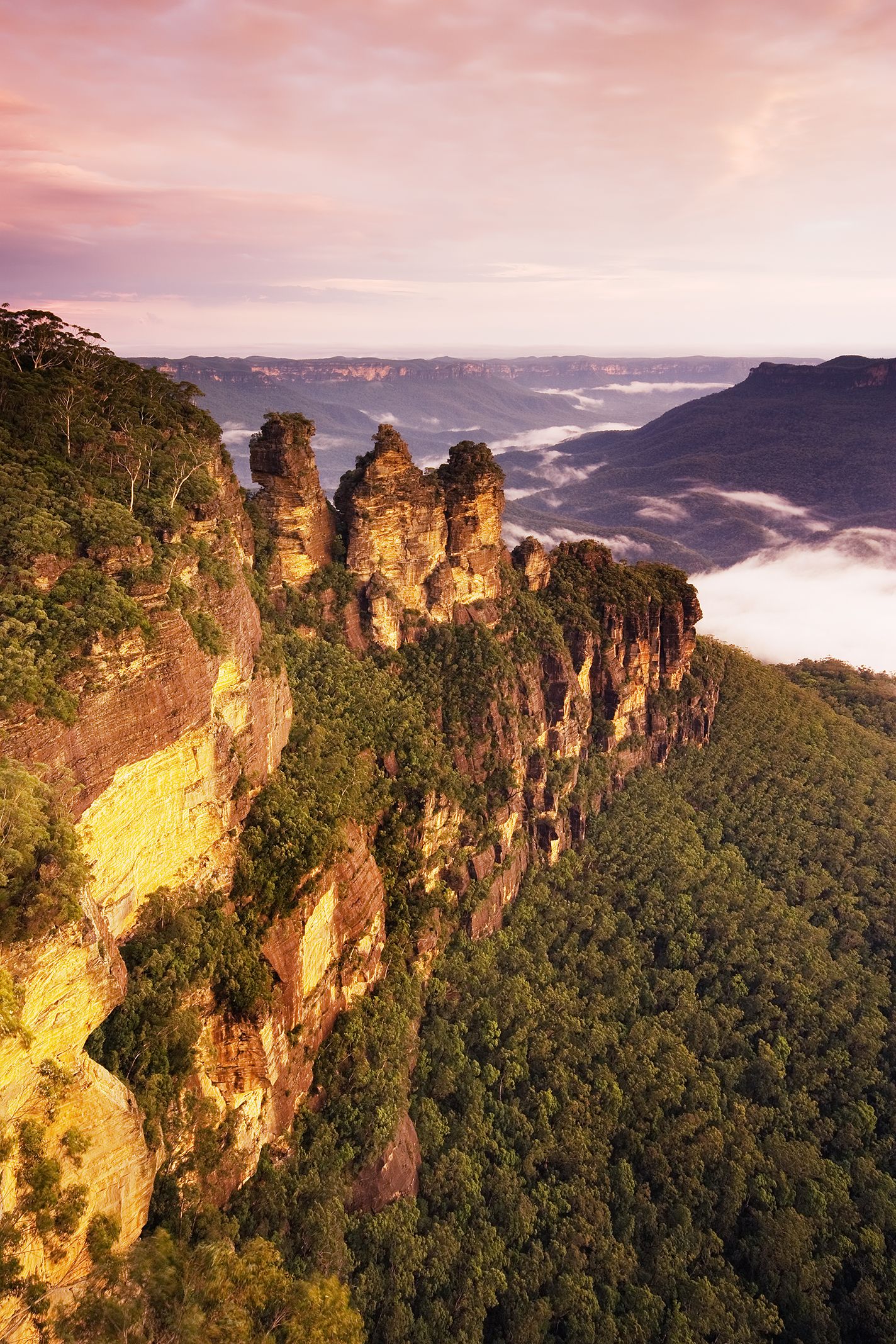
The Blue Mountains are not so much mountains as a great dissected sandstone plateau, cut by canyons and valleys so wide and deep that the view from the escarpment feels oceanic. Their name comes from a real optical effect: the eucalyptus forests below release fine droplets of volatile oil into the air, which scatter sunlight and wrap the valleys in a distinctive blue haze. The cliffs are dramatic — sheer walls of honey-coloured sandstone, hanging swamps, and waterfalls plunging into rainforested gullies, with the Three Sisters rock formation the best-known landmark. The plateau is a global centre of eucalypt diversity, with more than a hundred species, and in 1994 a remote canyon here yielded the Wollemi pine, a tree previously known only from 90-million-year-old fossils and assumed long extinct. It is a UNESCO World Heritage Site.
Why visit
Standing on an escarpment above a blue-hazed sea of eucalypt forest, then descending into rainforest gullies and waterfalls — all within a couple of hours of Sydney — makes this one of the most accessible great wilderness landscapes anywhere.
What to know before you go
🗓️ Best time
Spring and autumn (roughly September–November and March–May) for mild walking weather and clear views; summer can be hot with bushfire risk, winter crisp and sometimes misty.
🧭 Getting there & access
About 1–2 hours west of Sydney in New South Wales, easily reached by train or car to Katoomba and Blackheath; lookouts, the Grand Canyon track, and cliff-top walks start right from the towns.
Good to know
- Base in Katoomba or Blackheath and walk the cliff-top tracks at dawn.
- Check fire danger ratings in summer before setting out on any walk.
- Descend into a valley — the rainforest gullies feel worlds away from the rim.
Plan your visit
Moderate🧭 Getting there
From Katoomba, New South Wales, Australia
- Take the train Sydney → Katoomba — roughly 2h
- Walk or take the local bus to Echo Point and the Three Sisters
- Descend into the valley on the Scenic World railway or the Giant Stairway
- Total travel
- Around two hours from Sydney
- Time at site
- A full day, easily two
- Access
- The Blue Mountains are an easy day trip from Sydney by train, with the headline view — the Three Sisters from Echo Point — free and a short walk from Katoomba. The bushwalks range from a flat clifftop stroll to the steep Giant Stairway down into the Jamison Valley, and Scenic World runs a railway and cableway for those who would rather ride. Two cautions: the weather up here is cooler and mistier than the coast and can close the view without warning, and in a hot, dry summer bushfire risk can shut trails entirely — check fire warnings before you go.
🎒 What to bring & consider
- A warm layer and a rain jacket, since the plateau is markedly cooler and more prone to cloud than Sydney below
- Proper shoes for the Giant Stairway and valley trails, which are steep, stepped and slippery when damp
- A check of fire warnings in summer, when total fire bans can close the bushwalks completely
- Water and sun cover for the exposed clifftop sections between lookouts
- A little cash or card for the Scenic World rides if you would rather not walk back up out of the valley
👁️ What to expect
- Crowds
- Echo Point and Scenic World are busy midday and at weekends. The longer trails quickly empty out.
- Conditions
- Cool, often misty highland, with easy lookouts and some genuinely steep valley descents.
- Facilities
- Full in Katoomba and Leura — cafés, shops, toilets — and at Scenic World and Echo Point.
- The view
- The Three Sisters from Echo Point catching first or last light, with the blue eucalyptus haze filling the valley behind. Sunrise gives you the rock formation lit and the crowds still in bed.
Times and requirements are approximate and change with season, weather, and local rules — confirm permits, fares, and schedules with operators before you travel.
Natural riches of the area
- A vast dissected sandstone plateau with sheer escarpments
- Blue haze from volatile eucalyptus oils in the air
- Over 100 eucalypt species — a global centre of diversity
- The Wollemi pine, a 'living fossil' rediscovered in 1994
Local food
- Australian bush foods
- Native ingredients like lemon myrtle and wattleseed used in local cooking.
- Cool-climate produce & wine
- From the surrounding highlands and nearby valleys of New South Wales.
- Café culture
- The mountain towns are known for excellent coffee and mountain bakeries.
The Blue Mountains are less a range than a great sandstone plateau, sliced by valleys so wide and deep the view from the escarpment feels almost oceanic. The name is literal: the eucalypt forests below release fine droplets of volatile oil into the air, which scatter sunlight and wrap the whole landscape in a distinctive blue haze.
The cliffs are the drama — sheer walls of honey-coloured sandstone, hanging swamps, and waterfalls dropping into rainforested gullies, with the Three Sisters the most famous landmark of all. But the botany is just as remarkable. This is a world centre of eucalypt diversity, with over a hundred species, and in 1994 a remote canyon here gave up the Wollemi pine — a tree known previously only from 90-million-year-old fossils and presumed extinct for that long. A UNESCO World Heritage Site barely two hours from Sydney, it is wilderness on the city’s doorstep.
Blue Mountains: common questions
How do you get to Blue Mountains?
From Katoomba, New South Wales, Australia: Take the train Sydney → Katoomba — roughly 2h; Walk or take the local bus to Echo Point and the Three Sisters; Descend into the valley on the Scenic World railway or the Giant Stairway. Allow Around two hours from Sydney.
When is the best time to visit Blue Mountains?
Spring and autumn (roughly September–November and March–May) for mild walking weather and clear views; summer can be hot with bushfire risk, winter crisp and sometimes misty.
How long should you spend at Blue Mountains?
A full day, easily two. Around two hours from Sydney of travel from Katoomba, New South Wales, Australia.
What should you bring to Blue Mountains?
A warm layer and a rain jacket, since the plateau is markedly cooler and more prone to cloud than Sydney below Proper shoes for the Giant Stairway and valley trails, which are steep, stepped and slippery when damp A check of fire warnings in summer, when total fire bans can close the bushwalks completely Water and sun cover for the exposed clifftop sections between lookouts A little cash or card for the Scenic World rides if you would rather not walk back up out of the valley
Do you need a permit or guide for Blue Mountains?
The Blue Mountains are an easy day trip from Sydney by train, with the headline view — the Three Sisters from Echo Point — free and a short walk from Katoomba. The bushwalks range from a flat clifftop stroll to the steep Giant Stairway down into the Jamison Valley, and Scenic World runs a railway and cableway for those who would rather ride. Two cautions: the weather up here is cooler and mistier than the coast and can close the view without warning, and in a hot, dry summer bushfire risk can shut trails entirely — check fire warnings before you go.
Is Blue Mountains crowded, and what are conditions like?
Echo Point and Scenic World are busy midday and at weekends. The longer trails quickly empty out. Cool, often misty highland, with easy lookouts and some genuinely steep valley descents. Facilities: full in Katoomba and Leura — cafés, shops, toilets — and at Scenic World and Echo Point.
Added Updated
More wonders to explore