Rub' al Khali
📍 Southern Arabian Peninsula
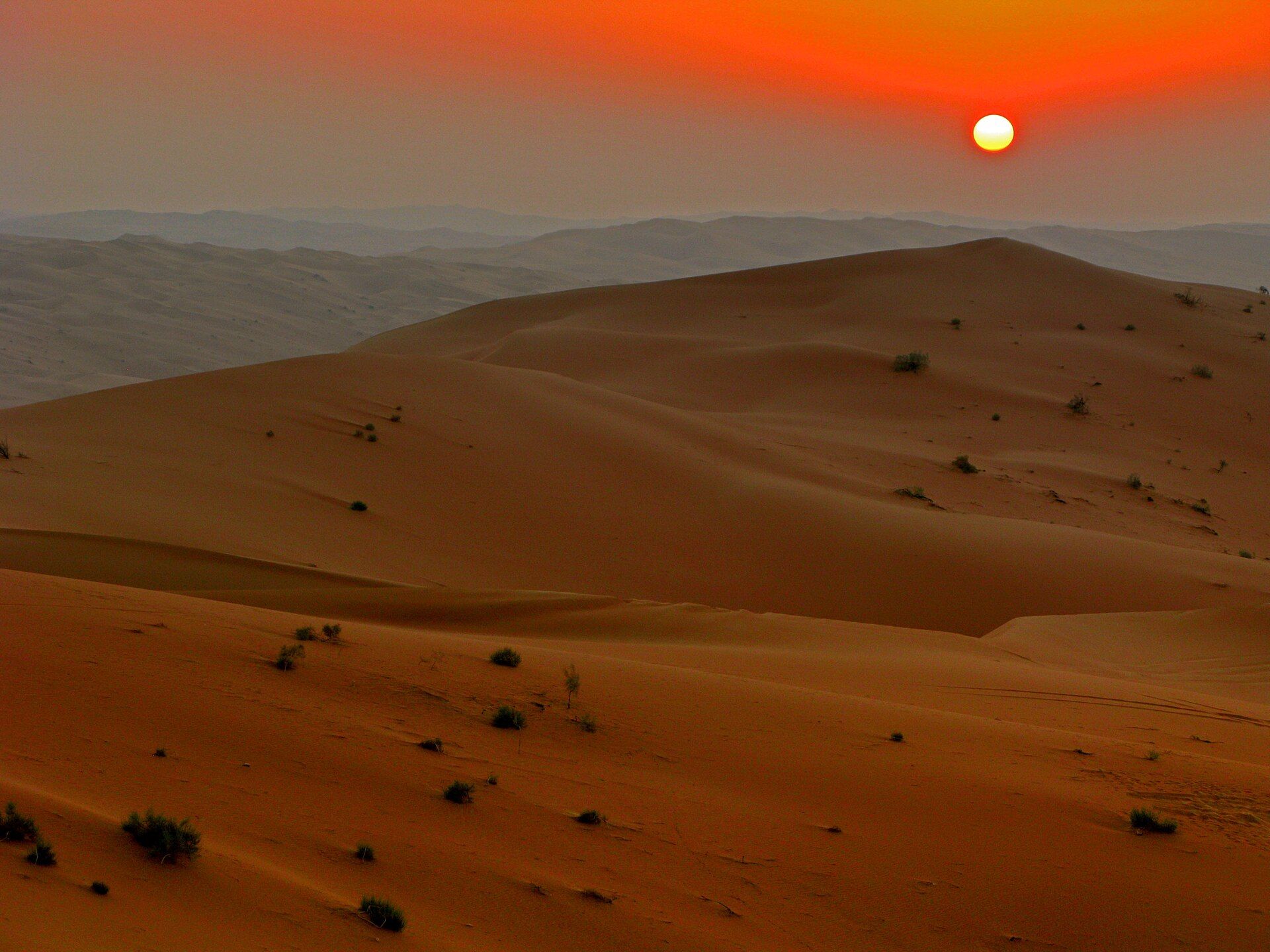
The Empty Quarter — the largest continuous sand desert on Earth, a sea of dunes up to 250 metres tall rolling across an area larger than France.
What makes it marvelous
The Rub' al Khali, 'the Empty Quarter', is the greatest continuous body of sand on the planet: roughly 650,000 square kilometres of dunes spilling across Saudi Arabia, Oman, the UAE, and Yemen — an expanse larger than France. Its dunes are colossal, some rising 250 metres, marching in long parallel ridges shaped by prevailing winds and glowing in shades from pale gold to deep apricot-red where iron oxide stains the sand. Rain is almost nonexistent, and for much of history it was among the last great blanks on the map, crossed by Europeans only in the 20th century. Yet it is not lifeless: oryx, gazelle, and desert-adapted plants persist at its margins, and beneath the sand lie the beds of ancient lakes, evidence that this immense void was once green and inhabited.
Why visit
Standing atop a 200-metre dune with an ocean of sand in every direction and absolute silence — then watching the stars come out over the emptiest place on Earth — is a profoundly humbling experience.
What to know before you go
🗓️ Best time
The cooler months (roughly November–March), the only comfortable and safe window; summer temperatures in the sands are extreme and dangerous.
🧭 Getting there & access
Most accessibly entered from Oman, via Salalah or the edge of the sands near the Empty Quarter road; travel into the dunes requires 4x4 convoys, guides, and full desert preparation.
Good to know
- Visit November–March; summer heat here is genuinely life-threatening.
- Never enter the sands alone — go with guided 4x4 convoys.
- Stay overnight for the desert silence and extraordinary night sky.
Plan your visit
Expedition🧭 Getting there
From Muscat (MCT) or Salalah (SLL), for the Omani side of the Empty Quarter
- Fly into Muscat
- Road Muscat → Nizwa → Bahla and on toward the sands — roughly 5–7h
- From Salalah the approach via Thumrait is about 3–4h
- Beyond the last town, travel is 4x4 convoy only
- Total travel
- Most of a day from Muscat to the desert edge
- Time at site
- 2–4 nights
- Access
- No permit for the accessible fringes, but the deep Empty Quarter is serious territory and routes near the Saudi or Yemeni borders require authorisation and local guides. Never travel in a single vehicle — convoy is the norm here for good reason. Sand conditions and dune routes shift, so use a guide who knows the current lines rather than an old GPS track.
🎒 What to bring & consider
- Two vehicles minimum with recovery gear, sand ladders and a compressor for airing tyres down and back up — one stuck vehicle alone out here is a genuine emergency, not an inconvenience
- Water far beyond any estimate, plus a real fuel margin
- Satellite communications; there is no coverage at all
- Sun protection and a headwrap for blowing sand
- Navigation you actually trust, because the dunes look identical and there are no landmarks to correct by
👁️ What to expect
- Crowds
- Effectively none once you are past the fringe camps.
- Conditions
- Extreme heat, soft high dunes demanding real driving skill, and a total absence of services.
- Facilities
- A few desert camps on the accessible edge. Nothing beyond them.
- The view
- The great dunes only have form in low sun, and the scale needs something in frame for reference. Summer here is dangerously hot — the cooler months are the only sensible window.
Times and requirements are approximate and change with season, weather, and local rules — confirm permits, fares, and schedules with operators before you travel.
Natural riches of the area
- The largest continuous sand desert on Earth (~650,000 km²)
- Dunes rising up to ~250 m in long wind-shaped ridges
- Iron-oxide-tinted sand in gold and apricot-red
- Beds of ancient lakes beneath the sand; oryx and gazelle at the margins
Local food
- Shuwa
- Omani spiced meat slow-cooked for hours in an underground pit oven.
- Dates & Omani coffee
- The traditional welcome across Arabia — dates with cardamom coffee.
- Camel & rice dishes
- Camel meat with spiced rice, long a staple of Bedouin desert life.
The Rub’ al Khali — ‘the Empty Quarter’ — is the greatest unbroken body of sand on Earth. Roughly 650,000 square kilometres of dunes spill across southern Arabia, an expanse larger than France, and the dunes themselves are colossal: some rise 250 metres, marching in long parallel ridges shaped by the prevailing winds, glowing from pale gold to deep apricot-red where iron oxide stains the grains.
Rain here is almost nonexistent, and for most of history this was one of the last true blanks on the world map, crossed by outsiders only in the twentieth century. Yet it is not quite lifeless — oryx and gazelle persist at its margins — and beneath the sand lie the beds of ancient lakes, proof that this vast emptiness was once green and lived in. To stand on a great dune with sand in every direction, in near-total silence, and then watch the stars emerge, is about as humbling as travel gets.
Rub' al Khali: common questions
How do you get to Rub' al Khali?
From Muscat (MCT) or Salalah (SLL), for the Omani side of the Empty Quarter: Fly into Muscat; Road Muscat → Nizwa → Bahla and on toward the sands — roughly 5–7h; From Salalah the approach via Thumrait is about 3–4h; Beyond the last town, travel is 4x4 convoy only. Allow Most of a day from Muscat to the desert edge.
When is the best time to visit Rub' al Khali?
The cooler months (roughly November–March), the only comfortable and safe window; summer temperatures in the sands are extreme and dangerous.
How long should you spend at Rub' al Khali?
2–4 nights. Most of a day from Muscat to the desert edge of travel from Muscat (MCT) or Salalah (SLL), for the Omani side of the Empty Quarter.
What should you bring to Rub' al Khali?
Two vehicles minimum with recovery gear, sand ladders and a compressor for airing tyres down and back up — one stuck vehicle alone out here is a genuine emergency, not an inconvenience Water far beyond any estimate, plus a real fuel margin Satellite communications; there is no coverage at all Sun protection and a headwrap for blowing sand Navigation you actually trust, because the dunes look identical and there are no landmarks to correct by
Do you need a permit or guide for Rub' al Khali?
No permit for the accessible fringes, but the deep Empty Quarter is serious territory and routes near the Saudi or Yemeni borders require authorisation and local guides. Never travel in a single vehicle — convoy is the norm here for good reason. Sand conditions and dune routes shift, so use a guide who knows the current lines rather than an old GPS track.
Is Rub' al Khali crowded, and what are conditions like?
Effectively none once you are past the fringe camps. Extreme heat, soft high dunes demanding real driving skill, and a total absence of services. Facilities: a few desert camps on the accessible edge. Nothing beyond them.
Added
More wonders to explore