Rotorua Geothermal Field
📍 Bay of Plenty, North Island, New Zealand
A landscape that steams, bubbles, and erupts — geysers, boiling mud pools, and mineral terraces in impossible colours, at the heart of Māori cultural life.
What makes it marvelous
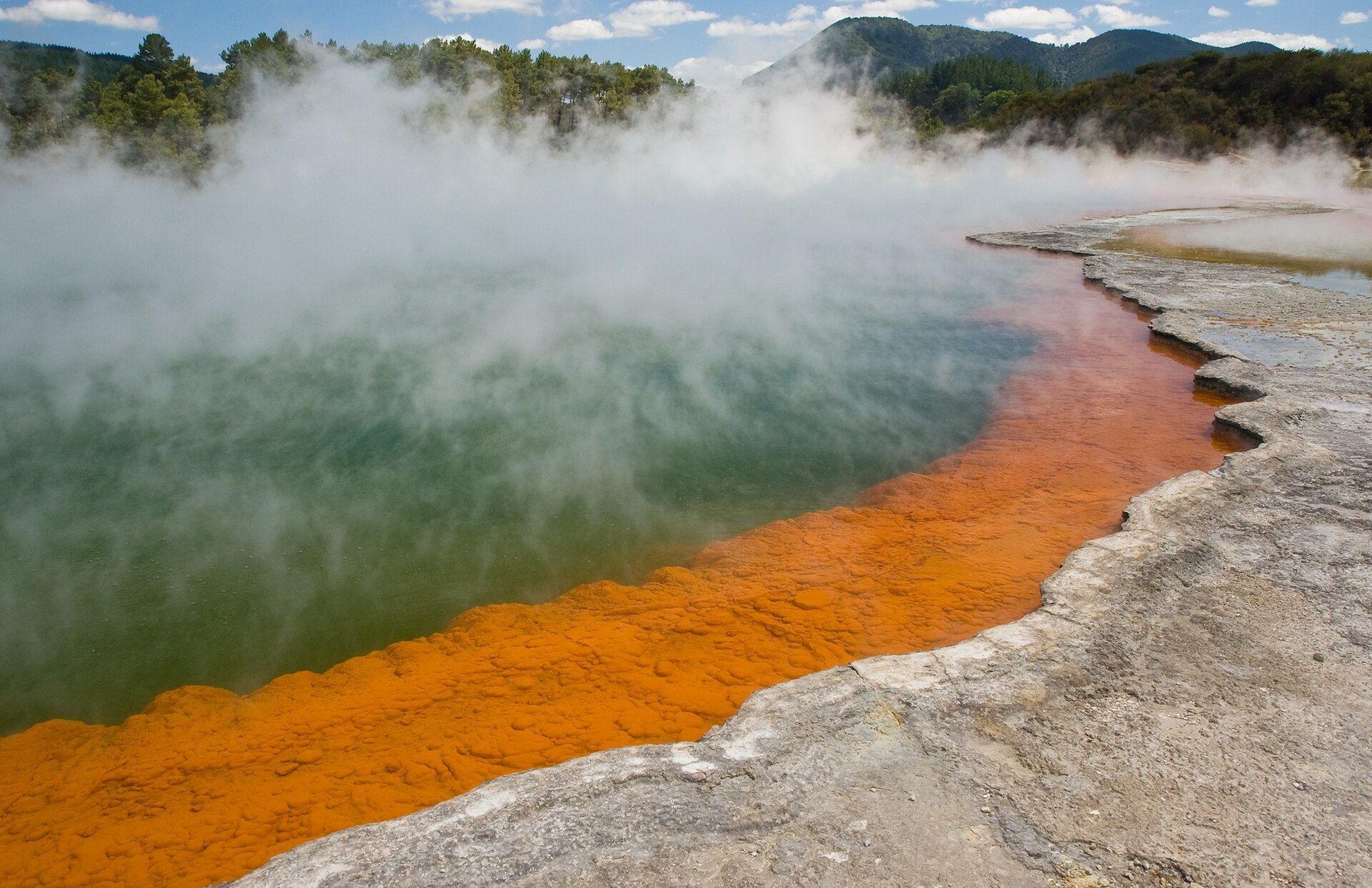
Rotorua sits atop one of the most active geothermal fields on Earth, within the Taupō Volcanic Zone where the Pacific plate dives beneath New Zealand and heats groundwater to boiling just below the surface. The result is a landscape in constant motion: the Pōhutu geyser, which erupts many times a day and can throw water 30 metres up; craters of grey mud that plop and burst like porridge; and, at Wai-O-Tapu, mineral pools in colours that look artificial — the Champagne Pool fringed in brilliant orange from arsenic and antimony compounds, and the Devil's Bath a startling chartreuse green. The whole town smells faintly of sulphur. This has been the heartland of the Te Arawa Māori for centuries, who have long used the geothermal heat for cooking and bathing, and their living culture is inseparable from the landscape.
Why visit
Watching a geyser fire, walking past neon-coloured mineral pools and boiling mud, and eating a hāngī meal cooked in geothermal steam makes Rotorua a uniquely vivid encounter with both a living landscape and living Māori culture.
What to know before you go
🗓️ Best time
Year-round — the geothermal features perform in any weather. Spring and autumn (roughly September–November and March–May) bring mild temperatures and thinner crowds; cold days make the steam most dramatic.
🧭 Getting there & access
In the central North Island, about three hours from Auckland by road; the geothermal parks (Te Puia, Wai-O-Tapu, Waimangu) are a short drive from Rotorua town and have boardwalk trails.
Good to know
- Come on a cold morning — the steam is far more dramatic in cool air.
- Stay strictly on marked boardwalks; the ground crust can be lethally thin.
- Pair the geothermal parks with a Māori cultural experience and hāngī meal.
Plan your visit
Easy🧭 Getting there
From Rotorua (ROT), or by road from Auckland
- Fly Auckland → Rotorua — about 50 minutes
- Or drive from Auckland — roughly 3h
- The geothermal parks sit 15–30 minutes apart around the town
- Total travel
- Half a day from Auckland
- Time at site
- Two days if you want to see more than one geothermal park
- Access
- Each geothermal park is separately owned and ticketed, several of them by Maori trusts, and there is no single pass covering them. The Lady Knox geyser erupts at a set time each morning because it is induced with surfactant — worth knowing so you understand what you are watching. Parks close individual areas when ground activity shifts.
🎒 What to bring & consider
- Closed shoes; boardwalks get hot underfoot and the ground on either side is not safe to stand on
- The discipline to stay on marked paths — thin crust over boiling mud causes serious burns here every few years
- A rain layer, since the region is wet year-round
- A tolerance for the hydrogen sulphide smell, which is constant, harmless at these levels, and clings to your clothes afterwards
- Sun protection, because the boardwalks are largely unshaded
👁️ What to expect
- Crowds
- Wai-O-Tapu is busiest around the induced geyser time. Waimangu and the outlying parks are quieter all day.
- Conditions
- Flat boardwalks and gravel paths — easy walking, but hot, humid and sulphurous.
- Facilities
- Good: cafes, toilets and shops at each park, with the town close by.
- The view
- Steam is thickest and most dramatic on cold mornings, which is also when it hides the colours. The Champagne Pool's orange rim reads best in sun with the steam blowing aside.
Times and requirements are approximate and change with season, weather, and local rules — confirm permits, fares, and schedules with operators before you travel.
Natural riches of the area
- One of Earth's most active geothermal fields
- The Pōhutu geyser, erupting up to 30 m several times daily
- Boiling mud pools and vividly coloured mineral springs
- Geothermal heat long used by Te Arawa Māori for cooking and bathing
Local food
- Hāngī
- A traditional Māori feast cooked underground — in Rotorua, by geothermal steam.
- Freshwater eel & trout
- Long-standing foods of the region's lakes and rivers.
- Kūmara
- Sweet potato, a staple of Māori cooking.
Rotorua sits on top of one of the most active geothermal fields on Earth. Here, in the Taupō Volcanic Zone where the Pacific plate dives beneath New Zealand, groundwater is heated to boiling just below the surface — and the landscape never stops moving. The Pōhutu geyser fires many times a day, throwing water thirty metres into the air. Craters of grey mud plop and burst like thick porridge. The whole town smells faintly, unmistakably, of sulphur.
The colours are the strangest part. At Wai-O-Tapu, mineral pools glow in shades that look painted on: the Champagne Pool rimmed in brilliant orange from arsenic and antimony compounds, the Devil’s Bath an eerie chartreuse green. And this has been the heartland of the Te Arawa Māori for centuries, who have long cooked and bathed in the geothermal heat — a living culture inseparable from the steaming ground it stands on.
Rotorua Geothermal Field: common questions
How do you get to Rotorua Geothermal Field?
From Rotorua (ROT), or by road from Auckland: Fly Auckland → Rotorua — about 50 minutes; Or drive from Auckland — roughly 3h; The geothermal parks sit 15–30 minutes apart around the town. Allow Half a day from Auckland.
When is the best time to visit Rotorua Geothermal Field?
Year-round — the geothermal features perform in any weather. Spring and autumn (roughly September–November and March–May) bring mild temperatures and thinner crowds; cold days make the steam most dramatic.
How long should you spend at Rotorua Geothermal Field?
Two days if you want to see more than one geothermal park. Half a day from Auckland of travel from Rotorua (ROT), or by road from Auckland.
What should you bring to Rotorua Geothermal Field?
Closed shoes; boardwalks get hot underfoot and the ground on either side is not safe to stand on The discipline to stay on marked paths — thin crust over boiling mud causes serious burns here every few years A rain layer, since the region is wet year-round A tolerance for the hydrogen sulphide smell, which is constant, harmless at these levels, and clings to your clothes afterwards Sun protection, because the boardwalks are largely unshaded
Do you need a permit or guide for Rotorua Geothermal Field?
Each geothermal park is separately owned and ticketed, several of them by Maori trusts, and there is no single pass covering them. The Lady Knox geyser erupts at a set time each morning because it is induced with surfactant — worth knowing so you understand what you are watching. Parks close individual areas when ground activity shifts.
Is Rotorua Geothermal Field crowded, and what are conditions like?
Wai-O-Tapu is busiest around the induced geyser time. Waimangu and the outlying parks are quieter all day. Flat boardwalks and gravel paths — easy walking, but hot, humid and sulphurous. Facilities: good: cafes, toilets and shops at each park, with the town close by.
Added
More wonders to explore